Emancipations Podcast
Emancipations explores the intersection of Marxism, politics and philosophy. Hosted by Daniel Tutt. Join our study groups and support us at https://www.patreon.com/c/emancipations





Episodes

Nov 19, 2025
Nov 19, 2025
1 hr 47 min
I am joined by political theorist Benjamin Studebaker to discuss the retreat of the political and the concomitant rise in despair. How do we theorize this despair, and how does it differ from spiritual despair?
Please read Studebaker's article which is the focus of this discussion: "Political Despair and Moral Injunctions" https://bit.ly/469EqkQ

Nov 19, 2025
Nov 19, 2025
1 hr 39 min
My guest is Michael C. Behrent, a historian of French intellectual history and a leading scholar of Michel Foucault. Behrent has been at the forefront of an important debate about the legacy of Foucault's thought, and specifically his political influence on the contemporary left and the rise of neoliberalism. Behrent is also working on the thought of Michel Clouscard, the most important French Marxist from the 20th century you have likely never heard about. The second half of this conversation is a discussion on Clouscard's work, his critique of the wider ecosystem of French philosophy from the 60s and 70s and specifically his analysis of the ideology of "liberal libertarianism."
Michael C. Behrent is a professor of History at Appalachian State University. His scholarship has sought to historicize the work of the French philosopher Michel Foucault. This work evaluates the political significance of Foucault's reflections on free-market economics by situating his work in the shifting ideological landscape of France in the 1970s. And his current project seeks to show how Foucault’s thought was (to a significant degree) rooted in his upbringing in Poitiers, France from the 1920s to the 1940s. Behrent is also developing a project that seeks to reconstruct the thought of the “young Foucault” (spanning 1949 through to the mid-1960s). Behrent also writes about American politics and culture for several French publications, notably Esprit as well as Dissent, Foreign Policy, and Oxford University Press blog.
Read his article on Michel Clouscard here, "Michel Clouscard vs. the Hipster Left" https://bit.ly/3Kn6jO0

Nov 19, 2025
Nov 19, 2025
1 hr 38 min
I am joined by philosopher and scholar Zahi Zalloua to discuss the politics of resentment, and how to theorize the problematic concept of "ressentiment" and whether this concept can be applied to emancipatory ends. Is ressentiment a political affect that can be harnessed for revolutionary action? We discuss Zalloua's recent works: Fanon, Žižek, and Violence of Resistance and The Politics of the Wretched: Race, Reason, and Ressentiment.
Zahi Zalloua is Cushing Eells Professor of Philosophy and Literature and a professor of Indigeneity, Race, and Ethnicity Studies at Whitman College and Editor of The Comparatist. His most recent work includes Fanon, Žižek, and Violence of Resistance (2025), The Politics of the Wretched: Race, Reason, and Ressentiment (2024), Solidarity and the Palestinian Cause: Indigeneity, Blackness, and the Promise of Universality (2023), Being Posthuman: Ontologies of the Future (2021), Žižek on Race: Toward an Anti-Racist Future (2020), Theory’s Autoimmunity: Skepticism, Literature, and Philosophy (2018), and Continental Philosophy and the Palestinian Question: Beyond the Jew and the Greek (2017).

Nov 19, 2025
Nov 19, 2025
1 hr 28 min
My guest is the political economist Adam Hanieh, a foremost expert on the political economy of the Middle East, fossil capitalism and imperialism. We discuss the war on Gaza, the prospects of Palestinian statehood, the dominance of Gulf oil and how it shapes the ruling classes in the region and the status of labor struggles across the wider Middle East.
Professor Adam Hanieh is the author of six books including the most recent Resisting Erasure: Capital, Imperialism and Race in Palestine with co-authors Robert Knox and Rafeef Ziadah as well as Crude Capitalism: Oil, Corporate Power, and the Making of the World Market and Money, Markets, and Monarchies: The Gulf Cooperation Council and thePolitical Economy of the Contemporary Middle East which was awarded the 2019 British International Studies Association International Political Economy Group Book Prize.
Please support us on Patreon https://www.patreon.com/c/emancipations

Sep 22, 2025
Sep 22, 2025
1 hr 53 min
I am joined by Alan M. Wald to discuss his extensive work on the literary left and the history of intellectuals and the communist movement in America. We discuss Wald's new book of essays called "Bohemian Bolsheviks: Dispatches from the Culture and History of the Left" which features a number of Wald's more recent essays and interventions on the history of US communism, including essays that touch on Richard Wright, James T. Farrell, Mike Gold, Agnes Smedley, John Steinbeck, Lorraine Hansberry and many other writers who incorporated a commitment to the class struggle in their writing, and who were influential propagating socialist and communist ideals.
In this interview, we discuss the meaning of "realism" and why it is important to socialist writers, the founding of the communist party of America, the role of Trotskyism on US left intellectuals, the role of Browderism on the cultural development of the communist party in America, the legacy of The Romance of American Communism by Vivian Gornick, Wald's methodology as a researcher and writer, African American literature, the New Left and various individual authors.
Alan Maynard Wald is an American professor emeritus of English Literature and American Culture at the University of Michigan, Ann Arbor, and writer of 20th-century American literature who focuses on Communist writers; he is an expert on the American 20th-Century "Literary Left." Wald's subjects have included: 20th Century United States Literature; Realism, Naturalism, Modernism in Mid-20th Century U.S. Literature; Literary Radicalism in the United States; Marxism and U.S. Cultural Studies; African American Writers on the Left; Modernist Poetry and the Left; the 1930s (Literature); New York Jewish Writers and Intellectuals; 20th-Century History of Socialist, Communist, Trotskyist and New Left Movements in the U.S.; the 1960s Politics and Culture; Cold War Culture and Resistance; Old Left/New Left in U.S. Politics and Culture; and Film Noir and the Left.
Please join our Patreon to get early access to all interviews and to participate in our study groups https://www.patreon.com/c/emancipations

Sep 22, 2025
Sep 22, 2025
1 hr 54 min
My guest is art historian and Marxist thinker Angela Harutyunyan, who has joined us to discus the work of the Marxist philosopher Mikhail Lifshits. Lifshits was an important Soviet Marxist thinker who developed a theory of aesthetics that remained committed to the proposition that communism entails the overcoming of alienation. Lifshits offers a critique of modernism and theories on classicism and socialist realism that are deeply relevant to today's time. We discuss Lifshits's major works, key concepts and his wider philosophy of art and aesthetics. We also discuss an important debate on the concept of the ideal that occurred between Lifshits and Soviet Marxist Evald Ilyenkov.
Dr. Angela Harutyunyan is a founding editor of ARTMargins published by MIT Press and has published extensively on post-Soviet art, Marxist aesthetics, and curatorial theory. She is the author of "The Political Aesthetics of the Armenian Avant-garde: The Journey of the \'Painterly Real\'" and co-author of "After Revolution: Historical Presentism and the Political Eclipse of Postmodernity". Harutyunyan has taught at the American University of Beirut and the American University in Cairo. She is currently based at the Universität der Künste Berlin.
Please join our Patreon to support our efforts https://www.patreon.com/c/emancipations

Jul 31, 2025
Jul 31, 2025
2 hr 16 min
C. Derick Varn, host of the Varn Vlog is a Marxist theorist, poet and political commentator. Varn joins our show to discuss the protests and riots against ICE in Los Angeles and across the country that popped off in late spring and early summer 2025. We examine the history of riots in the US, the role of the left in the context of a second Trump presidency, how Marxists have theorized the return of riots and uprisings in our time (with a focus on communization theory) and what we might expect moving forward.
Please support our work by becoming a Patreon member https://www.patreon.com/c/emancipations

Jul 23, 2025
Jul 23, 2025
2 hr 21 min
Analytic philosophy is the leading form of philosophy in the English-speaking world and most academic philosophy departments are analytic. But what explains this power and what is the history of analytic philosophy. Where did it begin and how did it rise to such prominence? I am joined by philosopher Christoph Schuringa to explore the social history of analytic philosophy.
Analytic philosophy tends to think of itself as concerned with eternal questions, transcending the changing scenes of history. It thinks of itself as apolitical. This book, however, convincingly shows that the opposite is true. To this day, analytic philosophy is the ideology of the status quo. It may seem arcane and largely removed from the real world, but it is a crucial component in upholding liberalism, through its central role in elite educational institutions. Learn more about this book and acquire a copy here: https://bit.ly/4lhoHF5
SHOWNOTES:
We discuss why Christoph wrote the book, the origin of the analytic/continental divide, the meaning of logical positivism, Wittgenstein's influence and the various schools in Cambridge and Vienna that formed analytic philosophy.
The contradictions of the "linguistic turn" and the ways it failed to address social concerns.
Whether there are exceptions within analytic philosophy, or philosophers whose methods might offer a more robust engagement with the social and with radical philosophy.
The theory of the "colonization" of analytic philosophy in other disciplines, from ethics, to politics, to continental thinkers.
Can analytic philosophy shake off liberalism and if not why. If so, how?
#EmancipationsPodcast

Jul 22, 2025
Jul 22, 2025
1 hr 47 min
My guest is Dr. Francesca Antonini, a historian and scholar of Antonio Gramsci. Dr. Antonini teaches at the Ca' Foscari University in Venice Italy. Her latest book is an exhaustive study of Gramsci's theory of Bonapartism, and it is entitled, Caesarism and Bonapartism in Gramsci: Hegemony and the Crisis of Modernity. In this discussion, we examine the Marxist view of Bonapartism and how it differs from liberal theories, the different periods of Gramsci's thinking on the concept, how Bonapartism relates to fascism in Gramsci's thought and why Gramsci retains the idea of Caesarism even though Marx rejected it.
Please support us on Patreon at https://www.patreon.com/c/emancipations

Jul 22, 2025
Jul 22, 2025
2 hr 37 min
Ben Burgis joins us for a discussion on the analytic Marxism of G.A. Cohen and the implications of his reading of Marx for 21st century socialism. We discuss Burgis's essay in the new book Flowers for Marx available now with with Revol Press.
Support us at https://www.patreon.com/c/emancipations
Jun 24, 2025
Jun 24, 2025
1 hr 8 min
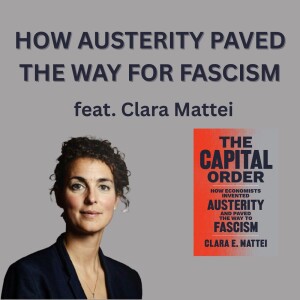
My guest Clara Mattei has written about austerity’s dark intellectual origins in her important new book The Capital Order: How Economists Invented Austerity and Paved the Way for Fascism. We discuss the main ideas of this book and how the historical roots of austerity emerge as a response by the ruling class to the social democratic gains of the working class following the First World War in Europe. At the core of Dr. Mattei's book is a powerful lesson for the left, namely that conditions of economic austerity have the tendency to sap the political resolve of the working class. Austerity depoliticizes the working class and this is why liberal economists implement it. We discuss the history of how economists and technocratic policymakers invented austerity and how we can challenge it.
Clara E. Mattei is a Professor of Economics and Director of the CHE, Center for Heterodox Economics, of The University of Tulsa Oklahoma, recently inaugurated in February 2025 (https://sites.utulsa.edu/chetu).
Please support my efforts by becoming a Patreon member https://www.patreon.com/c/emancipations
Jun 24, 2025
Jun 24, 2025
1 hr 24 min
My guest Sudip Bhattacharya studies and organizes the working class in New Jersey and he joins me to discuss the findings of his work. We explore some practical strategies for organizing the working class, the future of socialist politics and ways to overcome some of the main limitations to class politics in our time.
This conversation is inspired by a new essay Sudip wrote for The Hampton Reader. Check out the book published with Iskra Press
Sudip Bhattacharya is a doctoral candidate in Political Science at Rutgers University. You can find his work at outlets like Protean magazine, Jacobin, Current Affairs, Black Agenda Report, among others.
Jun 11, 2025
Jun 11, 2025
1 hr 43 min
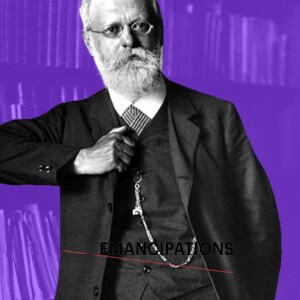
I am joined by Marxist historian Ian Szabo to discuss the revival of Karl Kautsky's revolutionary thought among contemporary Marxists. We discuss a recent article on Kautsky's theory of the dictatorship of the proletariat, and we address the predominant misreadings and misinterpretations that exist about Kautsky, and how his thought speaks to our present.
Read Ian Szabo's article "The Adolescence of a Concept: Dictatorship of the Proletariat in Karl Kautsky’s Revolutionary Writings (https://bit.ly/4hHoOaW).
Please support our efforts on Patreon https://www.patreon.com/c/emancipations
Jun 10, 2025
Jun 10, 2025
1 hr 56 min
Welcome to The Archimedean Point, a new series on the current political situation from a Marxist perspective. In our second episode, Daniel Tutt and Conrad Hamilton discuss the inadequacies of left-liberal accounts of racism and bigotry and why only a Marxist analysis can address the ideology of the far right. We also discuss new work by Daniel on Michel Clouscard and his book Neo-Fascism and the Ideology of Desire and Conrad's new essay in the book After Speculative Realism.
Episode One of The Archimedean Point can be found here (https://youtu.be/kTjaIm0XmZU?si=5cHD0k4gjnMsMGPT)
The Archimedean Point is a reference to a concept from Lukács's History and Class Consciousness that refers to "the point from which the whole of reality can be overthrown."
SHOWNOTES:
The Social Formation of the Far Right https://bit.ly/3XSpR0B
Neo-Fascism and the Ideology of Desire https://bit.ly/41jfkfL
After Speculative Realism https://bit.ly/4ckRup4
Jun 9, 2025
Jun 9, 2025
2 hr 2 min
Welcome to a special crossover podcast discussion on Michael Mann's first major feature film Thief (1981). While Michael Mann is best known for films like HEAT and Last of the Mohicans, Thief is by far his most political film. The film explores themes of labor, exploitation, class and the inner lives of criminals and convicts. We discuss the Marxist and Freudian undertones in this great masterpiece of cinema.
This conversation is hosted by Mtume Gant, filmmaker, professor and host of Within Our Gates podcast and Daniel Tutt, philosopher and host of the Emancipations podcast.
Please support us at https://www.patreon.com/c/emancipations
Please support Within Our Gates at https://www.patreon.com/c/Tumes/home
May 3, 2025
May 3, 2025
1 hr 32 min
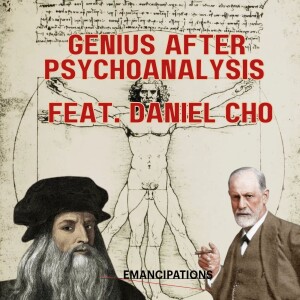
I am joined by K. Daniel Cho to discuss his provocative new book Genius After Psychoanalysis: Freud and Lacan which argues that genius is not exceptional talent or intelligence but is related to and illuminated by the psychological concept of sublimation. Beginning with a close examination of Freud's work on Leonardo da Vinci, Cho analyzes film, art, our relationship to nature, politics, group psychology, love, and philosophy to demonstrate that genius, far from an elitist notion, is universally available through a different approach to ideas of imperfection, disappointment, and failure. Learn more about the book.
K. Daniel Cho is Professor of Education at Otterbein University in Columbus, USA. He works on psychoanalysis in a variety of disciplinary contexts. He is the author of Psychopedagogy: Freud, Lacan, and the Psychoanalytic Theory of Education and coeditor of Marcuse’s Challenge to Education.
May 3, 2025
May 3, 2025
1 hr 51 min
My guest is Dr. Immanuel Ness, one of the foremost scholars of contemporary imperialism, workers’ social organization, Global South political economy, socialism and migration. We discuss the concept of economic imperialism in today's time and how the theory of imperialism has changed since the time of Lenin. We also discuss the theory of the labor aristocracy in Marxist thought, whether China is truly a socialist country and the status of working class struggles in China compared to America.
Immanuel Ness is an American academic, and Professor of Political Science at the City University of New York, Brooklyn, School of Humanities and Social Sciences. His academic focus is on workers' organization, migration, mobilization and politics. His latest book is entitled Migration as Economic Imperialism: How International Labour Mobility Undermines Economic Development in Poor Countries and is published with Polity Press. Learn more about our work and join our community at https://www.patreon.com/c/torsiongroups
Apr 7, 2025
Apr 7, 2025
1 hr 9 min
I am joined by the philosopher Mladen Dolar, one of the most important Lacanian philosophers working today. A founder of the Ljubljana school of psychoanalysis, Mladen Dolar has written important works on Hegel, Marx and numerous works on Lacanian thought. In this podcast, we discuss his experience studying with Lacan in Paris and the legacy of the 1960s on today's politics. We then turn to a discussion of Dolar's new book Rumors, a philosophical essay on the persistent problem of rumors from the time of Socrates to the present.
We examine how Socrates, Rousseau, Kafka and Kierkegaard each faced the problem of rumors and sought to overcome the stain of rumors on philosophy. Dolar writes that “rumors present another face of the big other, not the face of knowledge and truth but something that nobody quite believes to be true yet it unfailingly works and is given a questionable credence and general currency.” Learn more about Mladen Dolar's new book https://amzn.to/4b7WlJJ
Apr 1, 2025
Apr 1, 2025
1 hr 31 min
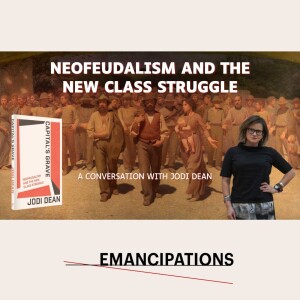
I am joined by political theorist Jodi Dean to discuss her provocative new book Capital's Grave: Neofeudalism and the New Class Struggle. Jodi Dean is one of the most vocal proponents of the "neofeudal thesis", the idea that capitalism has regressed to a neofeudal arrangement characterized by the delinking of capitalist accumulation from production, the end of competition, rent-seeking, predation and plunder. No longer can Marxists rely on a developmentalist theory of capitalism and a proletariat tied to productive labor as the means to abolishing capitalism. Dean argues that we must completely re-think the proletariat and that the global service sector points the way to a renewal of working class agitaiton and revolutionary activity.
Jodi Dean is a political theorist and professor in the Political Science department at Hobart and William Smith Colleges in New York state. Her books include The Communist Horizon, Crowds and Party, Comrade: An Essay on Political Belonging , Blog Theory and several others. Please check out Capital's Grave and order a copy here.
Join our Patreon to gain access to our interviews before they go live to the public and become a member of our study group collective where we read important books in Marxist thought and philosophy https://www.patreon.com/c/torsiongroups
Apr 1, 2025
Apr 1, 2025
1 hr 12 min
My guest Russell Jacoby is credited with coining the concept "public intellectual." He has written extensively on socialism in America, western Marxism and Freudian Marxism. We begin with a discussion of his criticism of Domenico Losurdo's recently translated work Western Marxism, we then discuss his recent Jacobin article "American Marxism Got Lost on Campus", the work of Christopher Lasch (Jacoby's Ph.D. advisor) and how Marxism can become "plain" again. Jacoby offers advice for Marxist scholars and writer to better reach the public and transcend academic specialization.
Russell Jacoby is the author of seven books including The Last Intellectuals: American Culture in the Age of Academe, Dogmatic Wisdom: How the Culture Wars Divert Education and Distract America and Dialectic of Defeat: Contours of Western Marxism. He is Emeritus professor of History at UCLA.
Apr 1, 2025
Apr 1, 2025
1 hr 57 min
We welcome socialist thinker and writer Nicolas D. Villarreal for a discussion on the thought of Louis Althusser, and how to navigate the political and ideological problems of the petty bourgeoisie. We begin with a discussion into whether professionals qualify as a class and what their precise function is for the perpetuation of the bourgeois state. Villarreal takes the view that professionals do not constitute a class but that they rather play an ideological function. This conversation clarifies many outstanding debates on today's left around how to understand the PMC, the working class, the function of the state, and how the state controls and represses the citizenry.
Nicolas D. Villarreal is the founder of the CASPER Forum, Palladium Magazine contributor, a contributor to Cosmonaut Magazine and he is the author of the novel “Caeruleus”, two time winner of the Howard Scammon Drama Prize. He is a graduate of the College of William and Mary specializing in Government and Economics. Subscribe to Nicolas' Substack A Pre-History of an Encounter at (https://nicolasdvillarreal.substack.com).
Apr 1, 2025
Apr 1, 2025
1 hr 38 min
My guest Michael A. McCarthy joins me to discuss his critique of "class abstractionism" or the tendency to theorize the working class in ways that result in vulgar and reductive conclusions. While McCarthy directs his critique to Vivek Chibber and his work The Class Matrix, we also discuss class abstractionism more broadly and how it appears on today's left. We speculate on ways to better theorize class while remaining critical of left-liberal identity politics. McCarthy, along with co-author Mathieu Hikaru Desan published their critique of class abstractionism in Sociological Theory, “The Problem of Class Abstractionism" in 2023. McCarthy is a critical sociologist and his work is on class structure and class formation. He explores the past and possible futures of radical economic democracy. McCarthy is faculty at the University of California, Santa Cruz and he is the author, most recently of The Master’s Tools published January 2025 with Verso Books. Learn more about the book here.
Feb 3, 2025
Feb 3, 2025
1 hr 52 min
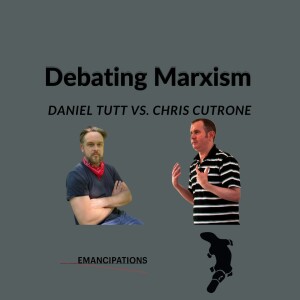
I have invited Chris Cutrone onto the show for a critical debate and discussion on our differences regarding Marxism in America, imperialism, interpretations of Nietzsche and the meaning of the left. Chris Cutrone is not someone that I agree with in matters of Marxism, but we have talked past each other for several years now and we have decided to talk out our differences directly, without a third party mediator.
One of my objectives in this discussion is to model the type of public debate that I think we need more of on the left. While Chris Cutrone is not someone that I agree with on hardly anything, his presence on the Marxist left is inescapable and it is important that we have the chance to confront our differences in the open air of the public, without control or censor.
Chris Cutrone is a college educator, writer, and media artist, committed to critical thinking and artistic practice and the politics of social emancipation. He is the original lead organizer and chief pedagogue of the Platypus Affiliated Society.
Jan 7, 2025
Jan 7, 2025
1 hr 23 min
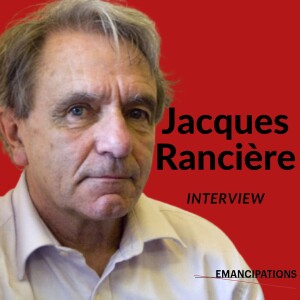
Please welcome Jacques Rancière to the Emancipations podcast. In the unlikely event you are not aware of the work of Jacques Rancière, he is seemingly impossible to classify as a thinker. He emerges from the May 68 moment, a student of Althusser who broke from his teacher and went on to develop some of the most uniquely inspiring works on emancipatory politics, aesthetics and most interestingly, he wrote a series of works on proletarian intellectuals in the 19th century.
I ask Jacques Rancière whether the seeming decline in ‘master philosophers’ from the time of French Theory is a good thing, and what a master philosopher is for him. I ask him what he thinks of the working-class today and its fragmented status. I ask him how we should assess the defeat of left-populism and what he thinks of Laclau and Mouffe and Hardt and Negri and other post-Marxist theorists of “radical democracy.”
I ask him if he thinks our time resembles the pre-1848 period wherein class antagonisms were rampant but the working-class was unorganized. Read this interview on my Substack (https://danieltutt.substack.com).
Please support my efforts to bring you these discussions by becoming a Patron on Patreon. As a Patron you will receive early access to all of my interviews and public seminars (https://www.patreon.com/c/torsiongroups).
Dec 16, 2024
Dec 16, 2024
1 hr 56 min
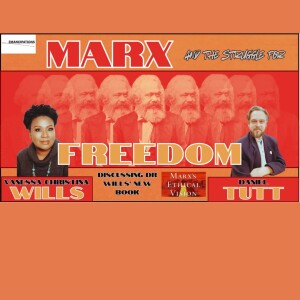
We are joined by Marxist philosophers Vanessa Wills and Daniel Tutt for a discussion moderated by Sam Greenhouse. This in-person podcast event delves into the philosophy of Marx and how Marx's thought relates to the ongoing quest for freedom in today’s world. We discuss Marx's Ethical Vision, Vanessa's important new book on Marx.
Please join us on Patreon (https://www.patreon.com/c/torsiongroups) to support our efforts.
Dec 4, 2024
Dec 4, 2024
1 hr 30 min
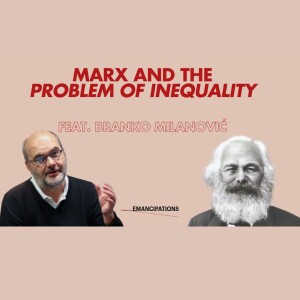
We welcome Branko Milanović for a discussion on inequality and Marxism and his latest book Visions of Inequality: From the French Revolution to the End of the Cold War. A sweeping and original history of how economists across two centuries have thought about inequality, told through portraits of six key figures.
Branko Milanovic obtained his Ph.D. in economics (1987) from the University of Belgrade with a dissertation on income inequality in Yugoslavia. He served as lead economist in the World Bank’s Research Department for almost 20 years, leaving to write his book on global income inequality, Worlds Apart (2005). He was a senior associate at the Carnegie Endowment for International Peace in Washington (2003-2005) and has held teaching appointments at the University of Maryland (2007-2013) and at Johns Hopkins University (1997- 2007). He was a visiting scholar at All Souls College in Oxford, and Universidad Carlos III in Madrid (2010-11). His book The Haves and the Have-nots (2011) was selected by The Globalist as the 2011 Book of the Year. Global Inequality (2016) was awarded the Bruno Kreisky Prize for the best political book of 2016 and the Hans Matthöfer Prize in 2018, and was translated into 16 languages. It addresses economic and political effects of globalization and introduces the concept of successive “Kuznets waves” of inequality. His most recent books are Capitalism, Alone, published in 2019, and Visions of Inequality, published in 2023
Nov 27, 2024
Nov 27, 2024
1 hr 11 min
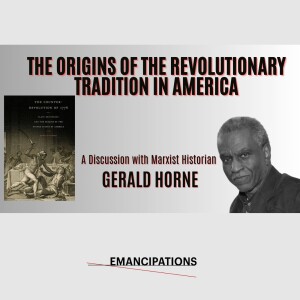
We are joined by Dr. Gerald Horne for a discussion on the meaning of the American Revolution and his extensive scholarship on re-assessing 1776 as a "counterrevoluton." At the heart of this discussion is the political and practical question for socialist politics in our time, namely: what is salvageable from 1776, and what is not? How do we read history from a materialist point of view?
Dr. Horne's scholarship traces the social forces that brought about the rebellion of 1776 back farther than most historians of the American Revolution have done, by showing how the international forces went to shape the early settlers in relationship to the threat of slave rebellions and resistance. Horne's work also sheds light on a far more extensive network of resistance and rebellion amongst enslaved Africans that has largely gone ignored by historians and he reveals how central the slavery question was to the wider movements of 1776.
Chapters
Opening and Intro to Dr. Horne
Is the American revolution a purely bourgeois revolution?
Can we salvage the optimism of 1776?
Is there a revolutionary tradition in America?
Understanding slave rebellions and resistance pre-1776
How can history help the "class vs. race" debate that often divides the left?
How is "counterrevolution" related to Trump? Is Trump Bonapartist or Fascist?
How can socialists contest the two capitalist parties in America?
Closing and future of Dr. Horne's scholarship and work
Please join our Patreon to support us and get early access to all of our interviews, seminars and videos (https://www.patreon.com/c/torsiongroups).
Dr. Gerald Horne holds the Moores Professorship of History and African American Studies. His research has addressed issues of racism in a variety of relations involving labor, politics, civil rights, international relations and war. He has also written extensively about the film industry. Dr. Horne is the author of more than thirty books and one hundred scholarly articles and reviews. His current research includes two forthcoming books: The Counter-Revolution of 1836: Texas Slavery, Jim Crow and the Roots of U.S. Fascism and Revolting Capital: Racism and Radicalism in Washington, D.C., 1918-1968. His other projects include a study of U.S. imperialism in Northeast Africa, principally Egypt and Ethiopia in the late 19th and early 20th centuries and a similar study concerning U.S. imperialism in Southeast Asia during the same period. He won the American Book Award for The Dawning of the Apocalypse: The Roots of Slavery, White Supremacy, Settler Colonialism, and Capitalism in the Long Sixteenth Century in 2021.
Nov 20, 2024
Nov 20, 2024
2 hr 13 min
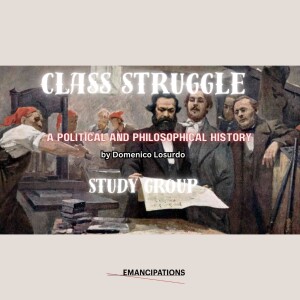
We turn to a study group on Domenico Losurdo's Class Struggle: A Political and Philosophical History, a crucial text for understanding class struggle within Marx and Engels’ thought that challenges populist understandings of class struggle and seriously incorporates gender, race, and post-colonial thought within the framework of class struggle. If you are interested in joining, we encourage you to support our efforts by becoming a paid patron if you can swing it, although that is not required (https://www.patreon.com/c/torsiongroups).
READING SCHEDULE:
Nov 12 - Read to page 52
Nov 26 - Read to page 120
Dec 10 - Read to page 198
Jan 7 - Finish book, final session (link will be provided for final session)
Nov 12, 2024
Nov 12, 2024
1 hr 41 min
A new interview with Henry Holland from Nietzsche POParts, a recently-founded Swiss magazine dedicated to debating Nietzsche's relevance today—essayistic yet grounded in the latest scholarship. Henry interviewed me on my book How to Read Like a Parasite (https://a.co/d/3RxOrXO). A meticulous reader and a careful scholar, Henry asks very intelligent questions that reflect a deep immersion into my book. It's clear that he had not only read the book but he was challenged by it.
If you feel so inclined or even challenged, be sure to pick up the book, available in Audible and in paperback (https://a.co/d/3RxOrXO). Read more from Nietzsche POParts and the text version of the interview will be published here (https://www.nietzsche-poparts.ch). Nietzsche POParts is set to expand to include English-language articles from 2025; until then browser translation extensions guarantee fascinating reads for those of you who don't read German!
Oct 30, 2024
Oct 30, 2024
1 hr 25 min
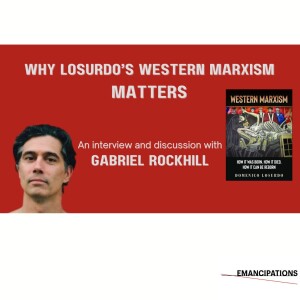
We are joined by philosopher and Marxist intellectual Gabriel Rockhill to discuss the relevance and importance of the recently translated work, Western Marxism (Monthly Review Press, 2024) by Domenico Losurdo. In this discussion, we analyze Losurdo's book with a focus on extracting the most seminal insights and lessons from the text. We discuss the various Western Marxist thinkers that are critiqued in the text, from Michel Foucault, Hannah Arendt, Max Horkheimer, to Theodor Adorno and others. We discuss how this text can promote a shift in the western Marxist left in today's time and why it is hitting a nerve. Learn more about Western Marxism by Losurdo please visit (https://monthlyreview.org/product/western-marxism/).
Dr. Gabriel Rockhill is the Founding Director of the Critical Theory Workshop / Atelier de Théorie Critique, Professor of Philosophy and Global Interdisciplinary Studies at Villanova University, and the author or editor of ten books, as well as numerous scholarly and general public articles. He is also the Associate Director of Cultural Studies at Villanova University, Research Associate at the Laboratoire d’anthropologie politique – LAP (EHESS, Paris), one of the editors-in-chief of the World Marxist Review, and co-editor of the book series AIM–Anti-Imperialist Marxism.